The Thud vs. The Fishbed: F-105 Pilots and the MiG-21 Threat Over North Vietnam
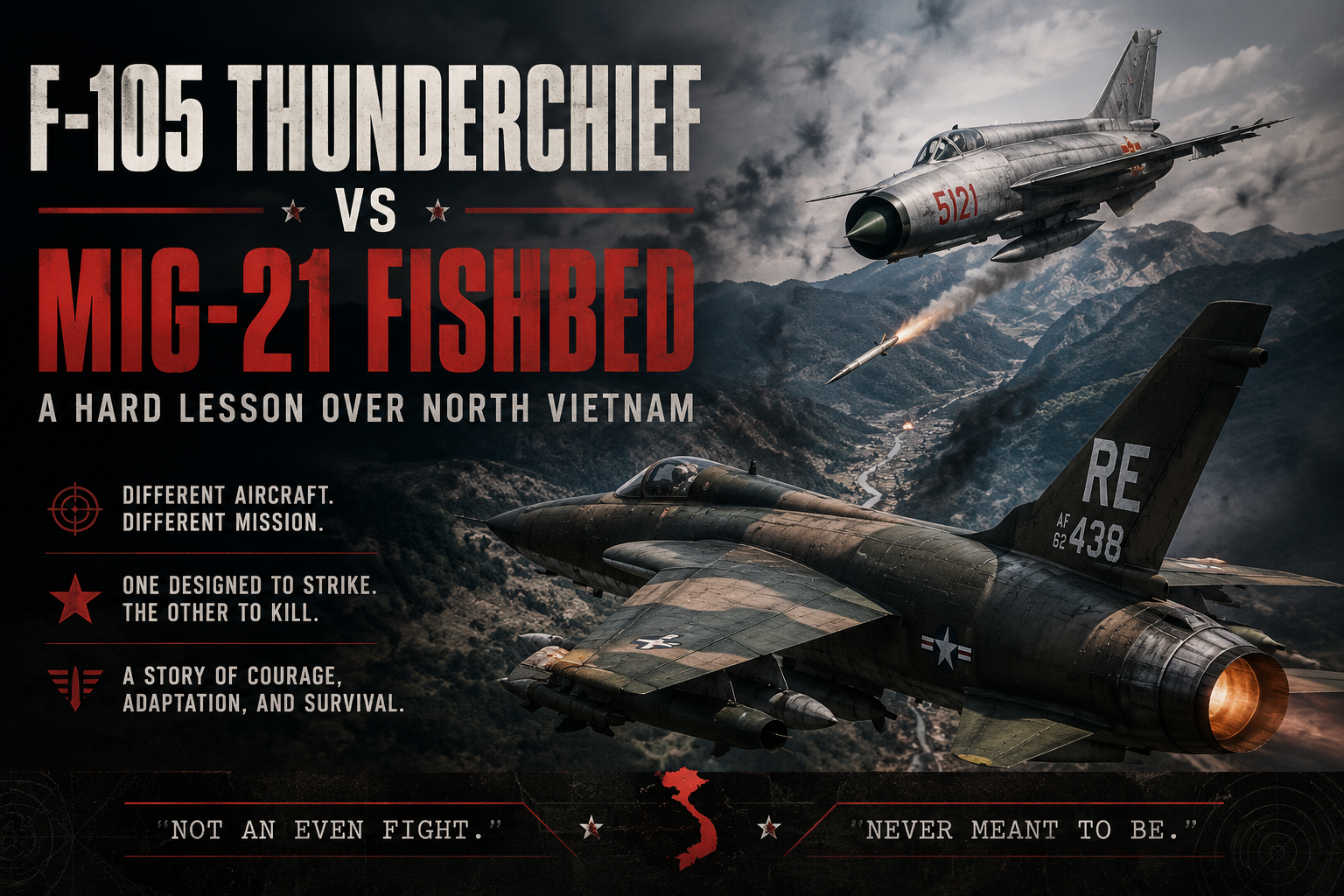
There is a moment that every F-105 Thunderchief pilot over North Vietnam learned to dread. You are low, fast, and heavy, threading through a valley somewhere northwest of Hanoi with a full bomb load and a SAM radar already painting you. Then the radio crackles. MiGs airborne. And somewhere above you, a sleek silver delta-wing is already diving.
This is not a story about an even fight. It was never meant to be.
The F-105: Built for One War, Flown in Another
The Republic F-105 Thunderchief was designed in the early 1950s with a very specific mission in mind: penetrate Soviet air defenses at supersonic speed, deliver a tactical nuclear weapon, and get out. It was enormous for a single-seat fighter, capable of carrying more ordnance than a World War II B-17, and it was blindingly fast at low altitude. The engineers at Republic Aviation built it to survive a very particular kind of threat in a very particular kind of war.
Vietnam was a different kind of war entirely.
By 1965, when Rolling Thunder kicked off and F-105s began flying daily strike packages into Route Package Six around Hanoi, the Thud was doing the exact opposite of what it was designed for. Instead of one high-speed nuclear dash, pilots were flying the same routes day after day, weighed down with conventional iron bombs, predictable ingress corridors, and rules of engagement that made tactical surprise almost impossible. The aircraft was exceptional. The situation was not.
Enter the MiG-21 Fishbed
The Mikoyan-Gurevich MiG-21 was everything the F-105 was not in the air-to-air role. Light, agile, purpose-built for interception, and armed with the Atoll heat-seeking missile, the Fishbed was designed to do one thing well: get in fast, take the shot, and energy-fight its way clear. Its delta wing gave it remarkable instantaneous turn performance, and its afterburning Tumansky R-11 could push it past Mach 2 in a clean configuration.
More importantly, the North Vietnamese Air Force knew exactly how to use it.
VNAF MiG-21 pilots were not trying to win a sustained dogfight against American airpower. They were trained to disrupt. A flight of MiG-21s rolling in from altitude on a strike package could force the F-105s to jettison their bomb loads defensively, break formation, and burn fuel evading, all without ever firing a shot. Every mission aborted without dropping ordnance was a victory for Hanoi. Every F-105 that had to dump its bombs to survive was a truck convoy that kept rolling.
That strategy worked far more often than the loss statistics suggest.
Why the Matchup Was So Brutal
Put yourself in the seat of a Thud driver on a typical strike day. You took off from Korat or Takhli in Thailand with six or eight 750-pound bombs hanging off your wings and centerline. You are flying formation across Laos and into North Vietnam at roughly 500 knots low, burning fuel fast. You have a SAM threat that forces you to stay low and fast and maneuvering. You have AAA from 23mm up to 85mm covering every approach corridor. And now, on top of all of that, you have a MiG-21 diving on your six from above with a missile already locked.
The F-105 was not helpless. It carried the M61 Vulcan 20mm cannon and could carry Sidewinders, and a clean Thud at low altitude was genuinely fast, capable of outrunning most threats in a straight line. But it did not turn well at combat weights, it bled energy fast in any sustained maneuvering fight, and its pilots were tasked with striking targets, not winning dogfights. The two missions were fundamentally incompatible, and the MiG-21 pilots knew it.
North Vietnamese ground controllers using Soviet-supplied radar could vector MiG-21s onto the strike package with remarkable precision. The Fishbed pilot often already knew where the F-105s were before visual contact. The Thud driver, deep in the weeds of a strike run with radar altimeter warnings and SAM uplinks competing for his attention, often did not know the MiG was there until the missile was already in the air.
The Pilots Who Flew It Anyway
Here is what does not get said often enough: the F-105 community produced some of the most accomplished and courageous combat aviators in American history, and they flew those missions knowing exactly what the odds looked like.
Names like Leo Thorsness, who earned the Medal of Honor over North Vietnam on April 19, 1967, attacking MiGs with his Thud after his wingman was hit and then orbiting the area to protect the downed crew until his fuel was nearly gone. Jack Donovan. Merlyn Dethlefsen. These men flew the most heavily defended airspace in the history of aerial warfare at that point, day after day, in an aircraft that was not optimized for the environment they were operating in.
The F-105 flew roughly 20,000 sorties over North Vietnam during Rolling Thunder. It absorbed losses that would end any modern air campaign before the second week. And its pilots kept going back.
That is the part of the historical air combat record that raw kill ratios do not capture.
What the MiG-21 Threat Changed
The campaign pressure from MiG-21 interceptions had lasting effects on American airpower doctrine that echo through military aviation history right up to the present.
The Navy stood up Top Gun, formally the Navy Fighter Weapons School, in 1969 specifically because of the degraded air-to-air performance statistics coming out of Vietnam. The Air Force followed with its own aggressor programs. The lesson learned, painfully and expensively, was that missile-only doctrine had been wrong, that visual merge dogfighting skills still mattered, and that rules of engagement constraining beyond-visual-range engagement were costing lives.
The F-105 was retired from the strike role by 1970, replaced by the more adaptable F-4 Phantom in most Strike packages. But the lessons written in the skies over Hanoi were not forgotten. They shaped the F-15, the F-16, the development of AMRAAM, and the entire philosophy of American air superiority doctrine for the next four decades.
All of it traces back, at least in part, to what happened when a bomb truck met a supersonic interceptor over the Red River Valley.
Flying This History in DCS World
One of the reasons historical air combat resonates so deeply in the simulation community is that these aircraft and these scenarios are not abstractions. They are flyable. DCS World's F-5E gives you a close analog to the MiG-21's performance envelope in the American inventory, and community-built missions regularly recreate the Route Pack Six environment with SAM networks, MiG CAPs, and strike package coordination that makes the tactical challenges viscerally real.
Flying a simulated strike package into a defended target zone, even in a game, forces you to think about ingress routing, threat deconfliction, fuel state, and mutual support in ways that pure reading about the subject never quite delivers. When a simulated MiG rolls in on your six during a bomb run, suddenly the decisions those Thud drivers made feel a lot less abstract.
That connection between historical understanding and hands-on flying is a big part of what keeps aviation simulation communities so passionate about getting the details right. The aircraft matter. The tactics matter. The history matters.
Frequently Asked Questions
Why was the F-105 used for strike missions in Vietnam if it was designed for nuclear delivery?
The F-105 was the most capable tactical strike aircraft the Air Force had available when Rolling Thunder began in 1965. Its speed, range, and payload capacity made it the right tool despite the doctrinal mismatch. There simply was not a better alternative in the inventory at the time, and the Air Force committed to it heavily throughout the early years of the campaign.
Did any F-105 pilots score air-to-air kills against MiG-21s?
Yes. F-105 pilots were credited with 27.5 aerial kills during the Vietnam War, including several MiG-21s, primarily using the M61 Vulcan cannon in close-range engagements. The Thud's gun proved far more reliable in the merge than the early Sidewinder variants, which had serious reliability problems in the high-heat, high-humidity Southeast Asian environment.
What made the MiG-21 effective against a technologically superior American force?
Tactics and ground control integration. VNAF MiG-21 pilots were vectored onto strike packages by Soviet-supplied radar networks with detailed positional data. They used hit-and-run interception rather than sustained combat, targeting the psychological and logistical disruption of forcing bomb loads to be jettisoned rather than trying to win a sustained engagement. The asymmetric approach offset the American numerical and technological advantages significantly.
How did the Vietnam air campaign change US fighter doctrine?
It was a foundational moment. The poor air-to-air kill ratios against North Vietnamese fighters, despite American technological advantages, drove the creation of Top Gun and Air Force aggressor programs. It revalidated close-in dogfighting skills that missile-only doctrine had dismissed, and it shaped the entire design philosophy of fourth-generation fighters like the F-15 and F-16 that followed.
Is the MiG-21 available to fly in DCS World?
The MiG-21bis is available as a full-fidelity module in DCS World through Magnitude 3 LLC, and it remains one of the most technically demanding and rewarding aircraft in the sim. Flying it on a multiplayer server against human opponents in a historically informed scenario is genuinely one of the great experiences the sim has to offer.
Where can I find multiplayer missions that recreate Vietnam-era air combat scenarios?
The DCS community has produced some excellent historically themed missions and campaigns set in the Vietnam era. Multiplayer servers running period-appropriate loadouts and SAM networks are a great way to experience these scenarios with real opponents. Fox3 Managed Solutions hosts dedicated DCS multiplayer servers built for exactly this kind of community-focused flying, with the stability and performance that these complex, high-player-count missions demand.
The story of the F-105 over North Vietnam is one of the most important chapters in air combat history, and it still has things to teach us about the relationship between aircraft design, doctrine, and the realities of actual combat. If you want to dig deeper, pull up some of Leo Thorsness's accounts of his April 1967 mission, or read Jack Broughton's "Thud Ridge." Then load up DCS, strap into something with a delta wing, and go see what those pilots were up against.
Blue skies and stable servers.
The Fox3 Team
Ready to fly?
Get a fully managed DCS World or IL-2 server. Most customers are flying within an hour.