Tacview Is Already Running on Your Fox3 Server. Here Is How to Use It.
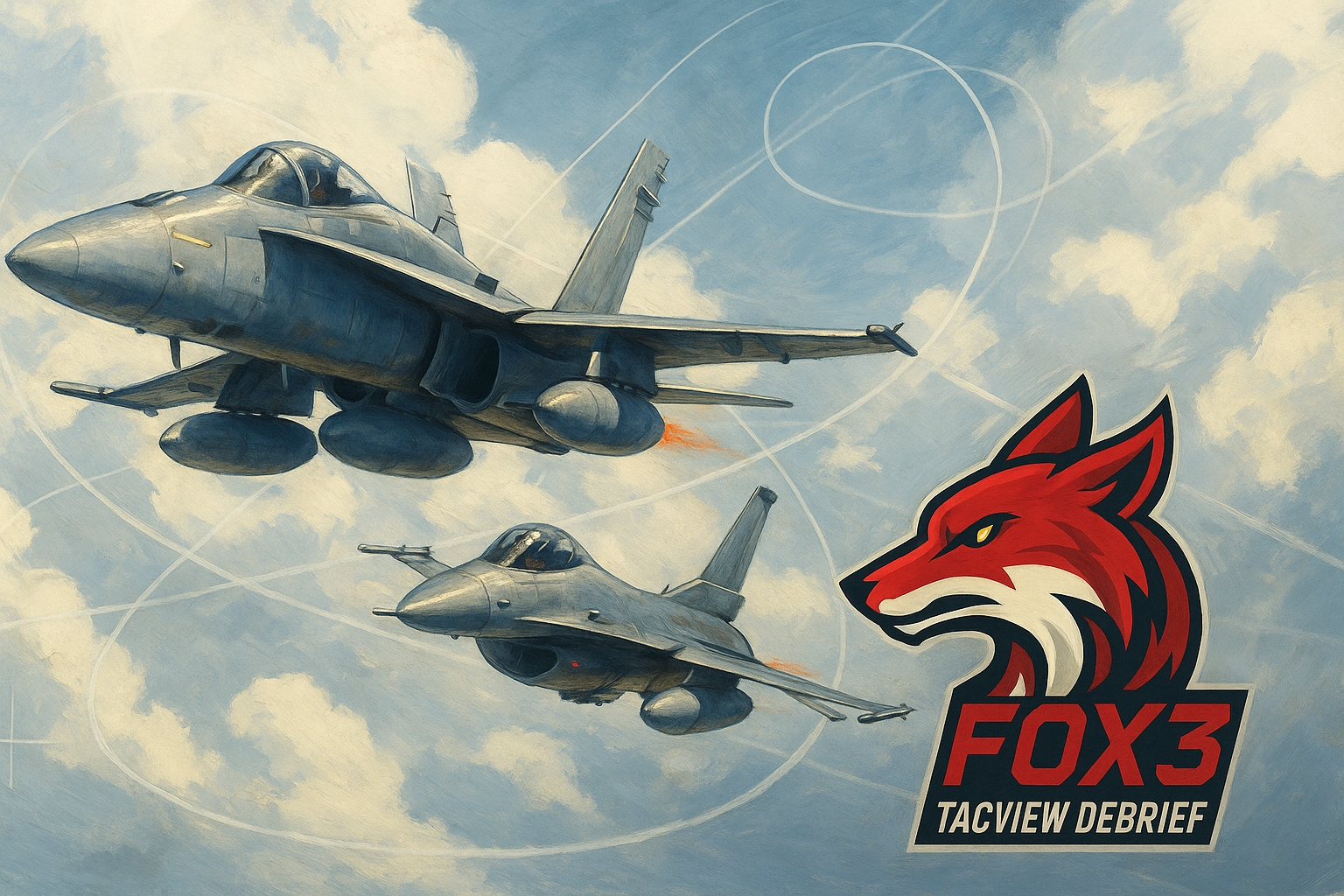
There is a reason real fighter pilots spend as much time in the debrief room as they do in the cockpit. Flying the sortie is only half the work. Knowing what actually happened up there is the other half.
Here is the part most people do not realize until someone tells them: if your server is Squadron Tier or above, Tacview is already installed, already configured, and already recording. You do not enable it. You do not edit a config file. You do not open a port. Every Fox3 DCS server from Squadron Tier up ships with Tacview in place before you ever log in, and the recordings land in a folder on your cloud drive named, helpfully, Tacview.
So this is not a setup guide. There is nothing to set up. This is a guide to actually using what you already have.
What You Already Have
Tacview is a 3D flight analysis tool that records every aircraft, weapon, and ground unit in your DCS session into a file called an ACMI (Air Combat Maneuvering Instrumentation) file. Think of it as a black box for the entire multiplayer engagement.
Because it runs on the server rather than on individual machines, it captures the full picture from every pilot's perspective at once. Nobody has to remember to hit record. Nobody has to have Tacview running locally, or even installed, for the recording to happen. The server does it for everyone, every time, automatically.
What lands in that file is genuinely impressive:
Full 3D track history for every aircraft in the session
Weapon release events, missile flyout paths, and impact or miss data
Altitude, airspeed, and G loading over time
Radar lock events and sensor activity
Kill and loss events with timestamps, tied to exact positions and energy states
That is not a flight log. That is a full debrief dataset, and it is sitting on your cloud drive right now.
Which Tiers Include It
Tacview is included on Squadron Tier, Wing Tier, Division Tier, and Air Superiority Tier. It ships alongside SRS and mod support on those plans.
Co-Op Tier and Value Tier do not include Tacview. Those are the compact shared plans built for small flights on a tight budget, and they leave the extras out to keep the price where it is. If you are on one of those and you want Tacview, moving up to Squadron Tier is a self service upgrade from your account dashboard. See server upgrades or the DCS server tier comparison for the full feature grid.
Finding Your Recordings
Every Fox3 server gets a cloud drive folder, set up for you during onboarding and reachable with your Fox3 user ID and password. It is the same place you drop missions and mods, and it has a consistent layout on every server we run:
Missions/for your .miz filesMods/for mod foldersLogs/for the server logTacview/for your ACMI recordings
That is it. Open the cloud drive, open Tacview, and your sorties are there waiting. Download the one you want and open it in Tacview on your own machine. Share the file with your squadron and everyone reviews the same engagement from their own seat.
A couple of things worth knowing so you are not left wondering:
Recordings appear after someone actually flies. The server writes a recording for a live session, so an idle server with nobody on it produces nothing. That is normal, not a fault. Fly a sortie, then check the folder.
A .trk file is not an ACMI file. DCS writes its own track files under Tracks, and people mix the two up constantly. Tracks are DCS replays and they are fragile. The .acmi files in your Tacview folder are the ones you want for analysis.
Live telemetry is already on too. Tacview's real time connection is enabled on Fox3 servers on the standard port, so a GCI controller, a JTAC, or an instructor watching a training flight can connect Tacview to your server address and watch the session unfold live rather than waiting for the file. Most squadrons still do their serious work after the mission, from the file, but the live option is there if you want it.
What a Tacview Debrief Actually Reveals
This is where the value is. A lot of pilots open the replay, watch the pretty 3D playback once, and move on. That leaves most of it on the table.
Here is what to actually look at.
BFM mistakes show up fast
Pull up your track and your opponent's track together. Look at your turn radius relative to theirs at the merge. Were you bleeding airspeed too early? Did you overshoot? Tacview shows the geometry in three dimensions, and the moment you see your flight path traced out next to your opponent's, the thing that felt like bad luck in the cockpit becomes an obvious mechanics problem.
Specifically, watch for:
Overshoot geometry at the merge, your nose tracking past theirs because closure got away from you
Vertical extension that gave away your energy state
Corner speed, by checking your airspeed at your hardest turn points against the module's actual corner velocity
Lag pursuit versus lead pursuit, because the lines tell the story plainly
Weapon employment calls out errors you cannot feel in the cockpit
Missed a Fox 2 shot? Tacview shows the missile flyout relative to target aspect and range at the moment of release. You will see immediately whether you fired inside minimum range, whether the target was in a beam aspect that defeated the seeker, or whether you simply had too much closure for the missile to guide.
For BVR shots, overlay your radar lock event against the target's altitude and aspect changes. Did the target notch you just before impact? Tacview shows you exactly when and how. That is something you can brief before the next sortie instead of arguing about it in comms afterward.
Formation and timing issues become visible
For a pair or a full four aircraft package, stack every track on the same playback and watch your formation discipline across the timeline. Did your wingman drift out of position during the ingress? Did your strike package arrive with a two minute spread instead of together? You see all of it, and you can put a timestamp on the moment it went sideways.
SEAD and strike coordination
For SEAD packages and coordinated strikes, Tacview shows SAM activation timing against your ingress track. You can see whether the HARM shot went out before the SAM could burn through, whether your popup attack was inside the threat ring, and what the engagement envelope looked like from the outside. This is the kind of analysis that used to need a dedicated mission debrief team.
Pairing Tacview with PilotRX
Tacview is excellent at showing you what happened. PilotRX takes the next step and tells you why it matters and what to change.
PilotRX is the Fox3 debrief tool built for DCS. You upload the ACMI file you just pulled off your cloud drive and it gives you a stats page for free, with a written fighter pilot debrief available if you want the full read. Instead of watching a replay and trying to diagnose yourself, you get a structured breakdown: energy management, weapons employment timing, threat reaction, each one flagged with context.
The loop looks like this:
Your Fox3 server records the engagement automatically. You do nothing.
You pull the
.acmiout of theTacviewfolder on your cloud drive.You do your raw visual review in Tacview.
You upload the same file to PilotRX for the structured debrief and specific callouts.
You take those callouts into your next brief and fly a better sortie.
One practical tip: PilotRX takes .zip.acmi or .txt.acmi up to 95 MB, and the zipped version is roughly a third the size. For a long session, upload the zip. Details are on the PilotRX help page.
That is a real debrief loop rather than watching the replay and moving on. For squadrons running regular training nights or competitive events, it is a meaningful edge. Pilots who debrief consistently improve faster. That is not a controversial take, it is just how skill development works.
A Few Housekeeping Notes
ACMI files grow with mission length, player count, and how much is moving on the map, and they do share your cloud drive with your missions and mods. If you fly daily, it is worth pruning the Tacview folder now and then, or pulling the ones you want to keep down to your own storage. Squadron through Division tiers include 5 GB of cloud storage and Air Superiority includes 10 GB. For this reason we prune ACMI files so they roll off every 48 hours.
Recording overhead on the server itself is small enough that it is not a factor on normal missions. We run it on the whole eligible fleet by default for exactly that reason. Very large missions will write larger files, but the performance cost is not what you should be worrying about.
You do need Tacview on your own machine to open the file. The free version opens ACMI recordings with some limits on playback and analysis, which is fine for a quick look. Squadrons doing serious debrief work usually have at least a couple of members on the full license.
And if you go looking and the Tacview folder is empty after a real sortie, open a ticket in our Discord. That is not something you should be troubleshooting yourself. It is our server and our job.
Frequently Asked Questions
Do I have to install or enable Tacview on my Fox3 DCS server?
No. Every Fox3 DCS server on Squadron Tier or above arrives with Tacview installed, configured, and recording. There is no config file to edit, no port to open, and no export script to place. The first time a pilot flies on your server, a recording is written.
Where do my Tacview recordings go?
Into the Tacview folder on your server's cloud drive, alongside Missions, Mods, and Logs. You reach it with the Fox3 user ID and password set up during onboarding. The files are standard ACMI recordings that open in any copy of Tacview.
Which Fox3 tiers include Tacview?
Squadron Tier, Wing Tier, Division Tier, and Air Superiority Tier. Co-Op Tier and Value Tier do not include it. Upgrading to Squadron Tier or above is a self service change from your account dashboard.
Do all the pilots on my server need Tacview installed for recording to work?
No. Recording happens entirely on the server, so what individual pilots have installed makes no difference to whether the sortie is captured. They only need Tacview locally to open and review the file afterward.
Can pilots connect to Tacview live during a mission?
Yes. Real time telemetry is already enabled on Fox3 servers, so a pilot can point Tacview at your server address and watch the session as it happens. It is popular with GCI controllers and with instructors observing a training flight from outside the cockpit.
What is the difference between a .trk file and a .acmi file?
A .trk is a DCS track replay, written by DCS itself into the Tracks folder. A .acmi is a Tacview recording, written into the Tacview folder. They are not interchangeable. Tracks are fragile and often desync on playback. ACMI files are what you want for actual analysis.
How does PilotRX complement Tacview?
Tacview gives you the visual replay and the raw data. PilotRX reads the same ACMI file and gives you a structured debrief that identifies specific mistakes and explains the tactical context behind them. Used together, you get the full picture in three dimensions plus a clear explanation of what to work on before the next sortie.
The short version: you are already paying for one of the best debrief tools in the sim, it is already running, and the recordings are already in your cloud drive. Go open the folder.
You fly. We handle the rest.
Ready to fly?
Get a fully managed DCS World or IL-2 server. Most customers are flying within an hour.