From Hardcore Niche to Global Phenomenon: The Rise of DCS World Multiplayer
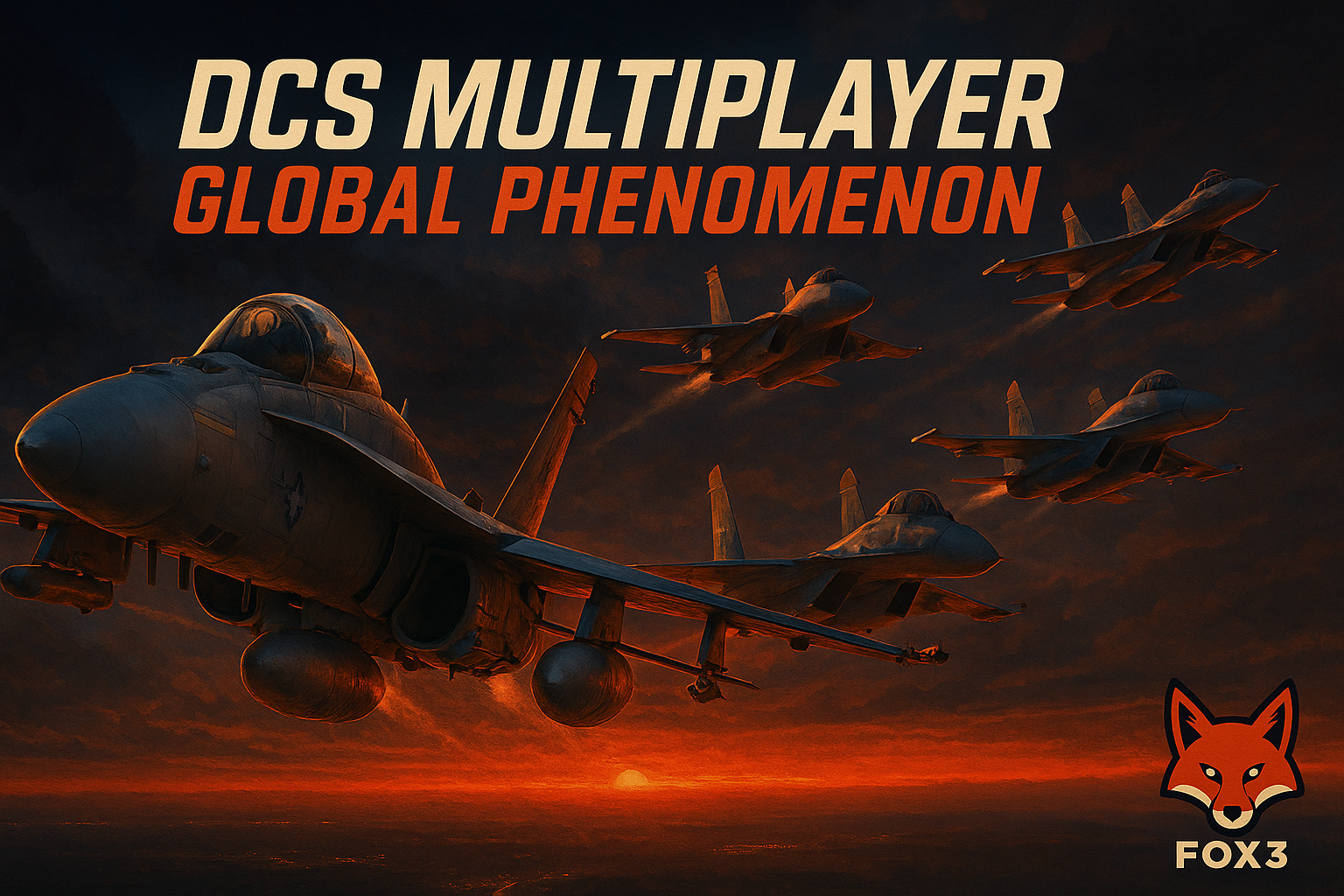
There was a time when telling someone you flew DCS World online meant explaining what DCS was, what a flight simulator was, and why anyone would spend three hours learning to cold start an F/A-18C just to get shot down in the first ten minutes. That time is over.
DCS World multiplayer has crossed a threshold that nobody could have predicted when Eagle Dynamics was still selling retail discs of Flaming Cliffs. The servers are fuller. The squadrons are bigger. The missions are more ambitious. And the community, the actual people behind the sticks and throttles, has become something genuinely remarkable.
Here is how it happened.
The Early Days: A Sim Built for the Devoted Few
Let's be honest about where this all started. DCS World in its early years was not an easy sell. You had a free-to-play launcher, a handful of premium modules priced like real aircraft components, a learning curve that could humble a real-world pilot, and a multiplayer infrastructure that required genuine patience and technical know-how just to join a server.
The community that grew up around those limitations was small, but it was intensely passionate. Forums. Discord channels. Homemade kneeboard PDFs. Guys mapping five hundred keyboard bindings on a Saturday afternoon just to get the RWR working correctly. That devotion built the foundation.
The pilots who stuck around during those years were not casual gamers. They were flight sim lifers, former military, aviation geeks, and people who genuinely believed that a $70 aircraft module was worth it because the systems modeling was accurate enough to learn real procedures from. That credibility became DCS's greatest long-term asset.
What Changed: The Tipping Point for DCS World Multiplayer
Several things converged to push DCS World multiplayer from niche hobby into something closer to mainstream. None of them happened in isolation.
Free-to-play lowered the barrier to entry. The decision to make the core DCS World platform free, with the Su-25T and TF-51D included, meant that curious pilots could get in the cockpit without spending a cent. Once someone is flying, even in a basic aircraft, the odds of them staying in the ecosystem go up dramatically.
YouTube and streaming brought the cockpit to everyone. Content creators like Spudknocker, Bogey Dope, and Growling Sidewinder pulled back the curtain on what DCS World actually looks like when flown by someone who knows what they are doing. Watching a well-executed SEAD package or a BVR engagement in the F-14 from a creator who can explain what is happening in real time, that is not just entertainment. That is recruitment.
The module library grew into something extraordinary. When DCS World multiplayer started featuring the F/A-18C Hornet, F-16C Viper, F-14 Tomcat, A-10C Warthog, AH-64D Apache, and an ever-expanding roster of maps from the Persian Gulf to Syria to the English Channel, the appeal stopped being theoretical. There was now something for almost every kind of virtual pilot. Naval aviators, close air support pilots, helicopter crews, warbird enthusiasts: all of them had a home.
VR made it visceral. Strapping into a simulated F-16C cockpit in virtual reality and looking over your shoulder to check six is not the same experience as playing a game. People who try DCS in VR for the first time describe it the way people describe their first real flight. That word-of-mouth has been powerful.
COVID-19 accelerated everything. When the world went home in 2020, a lot of people who had always been curious about flight simulation finally had the time to try it. DCS World benefited enormously from that wave of new interest. Servers that used to host fifty concurrent pilots started hosting hundreds.
The Community That Built Itself
The part that still gets me is the community itself. Not just the player count, but what virtual pilots have built on top of the platform.
Organized squadrons running structured operations with actual rank structures and mission briefs. Community-built campaigns that rival anything in the official module catalog. Discord servers with thousands of members coordinating real-time missions across multiple theaters. Tournaments. Award ceremonies. Dedicated training wings that onboard new pilots and teach them procedures that mirror actual military doctrine.
Groups like Carrier Air Wing Four are running movie-inspired community events with forty-pilot slots that fill up fast. Virtual wings are flying combined arms operations on Syria and the Persian Gulf with ground coordinators, AWACS callouts, and tanker tracks that would look familiar to anyone who has read a real-world ATO.
This is not just a game community anymore. That distinction matters.
DCS Servers Today
All of this growth has a practical side that anyone who has tried to run a DCS server will recognize immediately. More pilots means more demand for stable, capable server infrastructure. The days of throwing a mission on a gaming PC and hoping it holds together through a four-hour session are largely behind us for groups that take their flying seriously.
Modern DCS World multiplayer missions are complex. Persistent worlds. Dynamic campaigns. Combined arms with ground units, carrier operations, air traffic control, and SRS radio integration all running simultaneously. That kind of mission load requires real hardware, real bandwidth, and someone who understands how DCS server processes actually behave under load.
That is exactly why dedicated hosting has become a normal part of how serious DCS squadrons operate. Not a luxury, a baseline expectation. When sixty pilots are coordinating a strike package and the server goes down because someone's home internet hiccupped, the mission doesn't just pause. The momentum dies. The evening ends. People log off.
Fox3 Servers exists because that problem is solvable. Reliable, managed DCS server hosting means squadrons spend their time flying instead of troubleshooting. That is the whole idea.
Where DCS World Multiplayer Is Headed
Eagle Dynamics continues to expand the platform. New modules, new maps, infrastructure improvements, and a growing relationship with third-party developers mean the content pipeline is not slowing down. The Marianas, Afghanistan, the ongoing development of dynamic campaign systems: there is genuine forward momentum.
The community side is equally exciting. As more people discover DCS through streaming and social media, the influx of new virtual pilots keeps refreshing the ecosystem. Veterans mentor newcomers. Squadrons grow. New events get organized. The whole thing compounds.
The question the community is working through now is not whether DCS World multiplayer can sustain this growth. It clearly can. The question is how to scale the infrastructure, the social structures, and the training pipelines to match the ambition of what people are trying to build.
That is a good problem to have.
If you had told someone in the Flaming Cliffs era that digital combat simulation would one day support global virtual air wings, charity events, and community missions inspired by Hollywood blockbusters, they probably would have believed you. These are people who spent hours learning startup procedures for fictional fun. Ambition was never the issue.
The tools finally caught up.
Frequently Asked Questions
How many people play DCS World multiplayer?
Exact concurrent player counts are not publicly published by Eagle Dynamics, but the DCS World Steam presence, community Discord servers, and server browser activity all point to a community measured in the tens of thousands of active online pilots. Major community events regularly fill forty to one hundred pilot slots. The broader DCS World install base is estimated in the millions, with multiplayer representing a growing share of active sessions.
Is DCS World multiplayer beginner-friendly?
It depends on where you start. Jumping into a full-fidelity module on a high-population server as your first DCS experience is going to be overwhelming. But the community has built a genuine onboarding ecosystem: training servers, new pilot discords, mentorship programs, and guided multiplayer events designed specifically for people still learning the basics. If you find the right group, DCS World multiplayer is very welcoming.
What is the best DCS server for multiplayer?
That depends on what you are looking for. For large-scale persistent world gameplay, servers like How I Play's Persistent Server and various Blue Flag rotations have strong reputations. For structured squadron operations, a private or semi-private server hosted by a dedicated group tends to offer the best experience. Many serious squadrons run their own dedicated servers to maintain control over mission quality and server stability.
Do you need a powerful PC to play DCS World multiplayer?
DCS World is one of the more demanding flight simulators on the market, particularly in multiplayer with high unit counts. A modern GPU, fast RAM, and an NVMe drive for quick asset loading make a meaningful difference. That said, DCS is also scalable through graphics settings, and many pilots fly multiplayer successfully on mid-range hardware.
What is SRS and why do DCS multiplayer pilots use it?
SRS stands for Simple Radio Standalone. It is a free, community-built radio simulation tool that integrates with DCS World to simulate realistic in-cockpit radio communications in multiplayer. Pilots can tune to specific frequencies, experience signal degradation with distance, and communicate with ground controllers, AWACS, and wingmen the way real aviators would. Most serious DCS multiplayer servers run SRS because it adds a layer of immersion and coordination that in-game voice simply cannot match.
Why do DCS squadrons use dedicated servers instead of self-hosting?
Self-hosting a DCS server from a home PC works fine for small sessions, but it introduces variables that become serious problems at scale: home internet upload bandwidth, power reliability, PC resources split between playing and serving, and the need for someone to babysit the machine. Dedicated managed servers eliminate those variables. Mission performance is consistent, uptime is reliable, and pilots connect to something that will still be running at hour four of a long campaign night.
The growth of DCS World multiplayer is one of the better stories in the flight sim world right now, and it is still being written. If you are a virtual pilot looking to get more serious about your online flying, or a squadron leader thinking about what your server infrastructure should look like as your group grows, we would love to talk. Fox3 Servers has been hosting DCS and IL-2 servers for years, and we genuinely care about the community we serve.
Blue skies and stable servers out there.
The Fox3 Team
Join us on Discord | fox3servers.com
Ready to fly?
Get a fully managed DCS World or IL-2 server. Most customers are flying within an hour.