Why DCS World's Dynamic Campaigns Are Transforming How Squadrons Fly Together
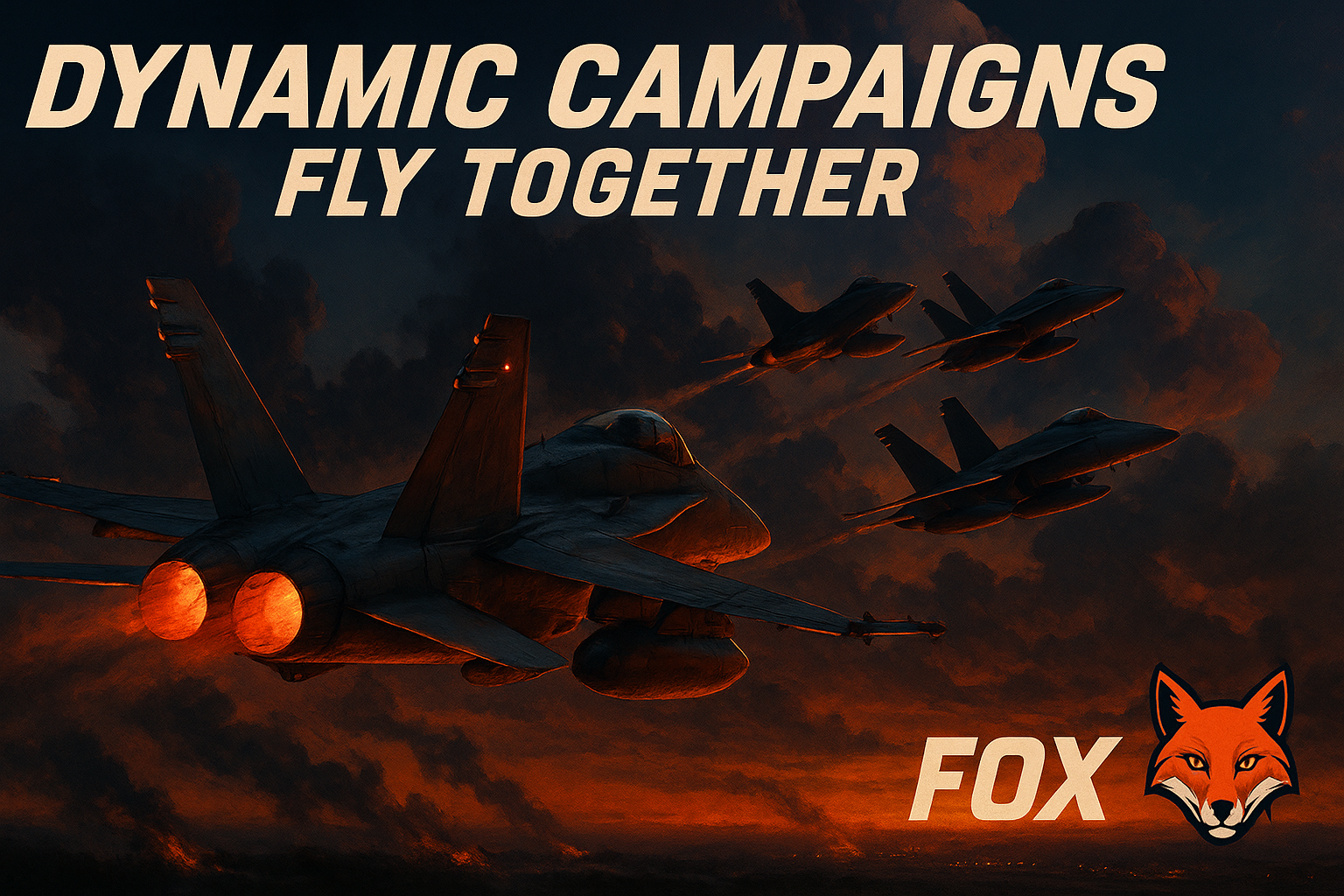
There is a moment in a well-run DCS multiplayer campaign where everything clicks. The AWACS is calling contacts. Your flight lead is already pushing. The SEAD package is working the threat ring ahead of you. And somewhere behind you, another human pilot is covering your six. Nobody scripted that. Nobody placed those pieces on the board manually. The campaign did it.
That is the promise of dynamic campaigns in DCS World, and it is one that the community has been chasing for a long time. We are closer to that promise than ever before, and the effect on how real squadrons fly together is hard to overstate.
What Is a Dynamic Campaign, Really?
Let's be honest: the phrase gets thrown around loosely. So let's define it.
A dynamic campaign is a persistent, evolving operational environment where the outcome of each mission actually matters to the next one. Enemy forces respond to losses. Supply lines can be severed. Airbases can change hands. The front line moves. If your strike package successfully destroyed that SAM site on Tuesday, it is still gone on Thursday. If you got beaten up and lost three aircraft, the enemy has more room to breathe.
This is fundamentally different from a scripted mission rotation, where the same objectives respawn on the same timer whether your squadron showed up or not. In a scripted server, the war never goes anywhere. In a dynamic campaign, the war is alive.
For DCS World multiplayer, that distinction matters enormously.
Why This Changes Everything for Squadron Flying
Squadrons in DCS World have always been able to fly together. That is not new. What dynamic campaigns add is consequence, and consequence is the engine that turns coordination into investment.
When actions carry forward, your squadron's schedule starts to mean something. A Monday evening CAS mission is not just a training hop; it is part of an ongoing effort to push the front line before the weekend assault. A Friday night strike package has context. There is a reason you are striking that particular airfield, and the whole squadron knows it.
Here is what that looks like in practice:
- Persistent ground stakes. Pilots care about the outcome because it affects what they fly into next session.
- Emergent roles. Some pilots naturally gravitate toward logistics protection. Others take on SEAD. The campaign rewards specialization because specialization produces results that carry forward.
- Real planning cycles. Squadrons start doing actual mission planning between sessions, not just showing up and picking a slot on the server.
- Storytelling. This one sounds soft, but it is powerful. Shared campaign history creates shared identity. "Remember when we lost the northern airfield in week two?" That story belongs to your squadron and nobody else.
None of that happens on a server where the map resets every six hours.
The Servers Behind the Experience
Here is where the rubber meets the ramp.
Dynamic campaigns are demanding. A persistent world with tracked unit states, moving front lines, and cascading logic running across multiple sessions requires a server that does not buckle. Dropped connections, lag spikes, and mid-mission crashes are frustrating in any multiplayer context. In a dynamic campaign, they can erase hours of coordinated effort and break immersion that took weeks to build.
This is exactly why more squadrons are moving away from self-hosted setups and toward dedicated managed infrastructure. The experience your pilots have in the cockpit is directly tied to the stability of the server underneath them. When the foundation is solid, the campaign world stays alive between sessions. When it is not, you are constantly fighting the infrastructure instead of the enemy.
At Fox3 Servers, we built our hosted DCS server platform specifically for communities running exactly these kinds of persistent, high-coordination multiplayer environments. Stable hardware, clean uptime, and the kind of reliability that lets your campaign world actually persist the way it is supposed to.
The Tools Making It Happen
So what is actually powering dynamic campaign experiences in DCS World multiplayer right now? A few worth knowing:
Liberation Campaign is the one most serious DCS squadrons have already heard of. It is an open-source dynamic campaign framework that generates and tracks a persistent operational picture across DCS missions. It handles base ownership, supply, air defense networks, and more. It is not a lightweight tool, but squadrons willing to invest time in it get a genuinely deep campaign experience.
Dynamic World and MOOSE-based frameworks extend mission scripting in ways the base mission editor was never designed to handle, giving mission designers the ability to build responsive, living environments without rebuilding from scratch each session.
DCS's own built-in dynamic campaign system has been in development for years and, while progress has been gradual, every update brings it closer to the persistent operational experience pilots have wanted since the early days. Eagle Dynamics has been clear that this is a long-term investment, and the community is watching it closely.
The tools are maturing. The infrastructure to support them is available. The main variable now is whether your squadron commits to the format.
What Squadrons Are Actually Experiencing
Talk to pilots who have completed a full Liberation campaign with a structured squadron and the feedback is consistent: it changes how they think about DCS World multiplayer entirely.
The casual "hop on, fly a sortie, hop off" model does not disappear, but it gets a second layer. Pilots who would normally only fly a session or two a week start showing up more because they have a stake in the outcome. New pilots learn their roles faster because the campaign creates natural context for mentorship. Senior pilots pass down tactics because those tactics produce results that persist.
Squadrons report that dynamic campaigns function almost like glue for their community. Retention goes up. Coordination improves. And the number of stories worth telling multiplies fast.
That is not a small thing. Community is the whole point of flight sim multiplayer.
Is Your Server Ready for a Dynamic Campaign?
If your squadron is thinking about launching a persistent campaign, a few practical questions are worth asking before you start:
- Can your server handle the load? Liberation and similar frameworks add scripting overhead. A server that runs smoothly with 10 pilots in a simple mission may show cracks when 20 pilots are in a complex dynamic environment.
- Do you have reliable uptime? Persistent campaigns require the server to be accessible between sessions for state saves and pre-flight planning. Sporadic availability kills momentum fast.
- Who is managing the server? Dynamic campaigns need occasional resets, mission file updates, and framework maintenance. If that burden falls entirely on your most enthusiastic volunteer, burnout is coming.
- What is your fallback when something breaks? Because something will break. Having a support path matters.
These are solvable problems. But they are real ones, and worth thinking through before your campaign kicks off.
The Bigger Picture
DCS World multiplayer has always had the aircraft. It has always had the maps and the weapons and the systems fidelity that no other flight sim on the planet can match. What dynamic campaigns are adding now is the operational layer that turns individual sorties into a shared story.
For the DCS community, this is a genuinely exciting moment. Squadrons are flying with more purpose than ever. Mission designers are building environments that respond and evolve. And the infrastructure to support persistent worlds is no longer something only large organizations can access.
The only question now is simple: is your squadron ready to commit to the campaign?
Frequently Asked Questions
What is a dynamic campaign in DCS World multiplayer?
A dynamic campaign is a persistent, evolving mission environment where the results of each session carry forward to the next. Base ownership, unit losses, and front line positions change based on what players actually accomplish. This is different from scripted mission rotations where the map resets on a timer regardless of player actions.
How is DCS World's dynamic campaign different from a regular multiplayer server?
On a standard DCS server, most objectives respawn and the strategic situation resets frequently. In a dynamic campaign, your squadron's actions have lasting consequences. Destroying a SAM site keeps it destroyed. Capturing an airfield means you can use it next session. The war progresses, which gives every sortie real operational weight.
What tools are available for running dynamic campaigns in DCS World?
The most widely used framework right now is the Liberation Campaign, an open-source tool that manages a full persistent operational picture including base ownership, supply lines, and air defense networks. MOOSE-based mission scripting and Eagle Dynamics' own in-development dynamic campaign system are also part of the picture. Each has different complexity levels and setup requirements.
What kind of server do I need to run a DCS dynamic campaign?
You need a stable, consistently available server with enough processing headroom to handle the scripting overhead that dynamic campaign frameworks add. Self-hosted solutions on gaming PCs or underpowered hardware often struggle with larger player counts and complex persistent environments. Many squadrons running serious campaigns use dedicated managed hosting specifically for this reason.
Why are squadrons getting more out of DCS multiplayer with dynamic campaigns?
Because consequence creates investment. When your actions in Tuesday's mission affect what you fly into on Saturday, you care about the outcome in a different way. Squadrons report better retention, more organic mentorship, improved coordination, and a stronger shared identity when they run persistent campaign formats compared to one-off mission rotations.
Does DCS World have a built-in dynamic campaign system?
Eagle Dynamics has been developing a native dynamic campaign system for DCS World, and it has been a long-term project with gradual progress. In the meantime, community-built frameworks like Liberation Campaign have filled the gap and are fully functional for squadrons willing to invest in the setup. The native system, when fully released, promises to make the format more accessible to the broader DCS community.
If your squadron is ready to take the leap into persistent campaign flying, the experience waiting on the other side is worth every hour of setup. And if the server side of things is the piece holding you back, that is exactly the problem Fox3 Servers exists to solve. We keep the infrastructure stable so your campaign world stays alive and your pilots stay in the cockpit where they belong.
Happy Flying.
From Fox3 Servers
Ready to fly?
Get a fully managed DCS World or IL-2 server. Most customers are flying within an hour.